
Generation 3 Grounds Automation: Why Integration Beats More Apps
I've spent years watching superintendents juggle 15+ apps just to keep a course playable. The technology exists—but the integration doesn't. Until now. This is the story of how we're moving from Generation 2 to Generation 3, and why it matters for every course operator ready to stop firefighting and start leading.
If you've ever pulled up to work and immediately opened four different apps before your first cup of coffee, you know the problem. One app for the mowers. Another for irrigation. A third for weather. A fourth for scheduling. And that's before we even talk about sensors, drones, or equipment tracking.
Each of these tools, on its own, is impressive. But together? They create chaos. And that chaos has a name: Generation 2.
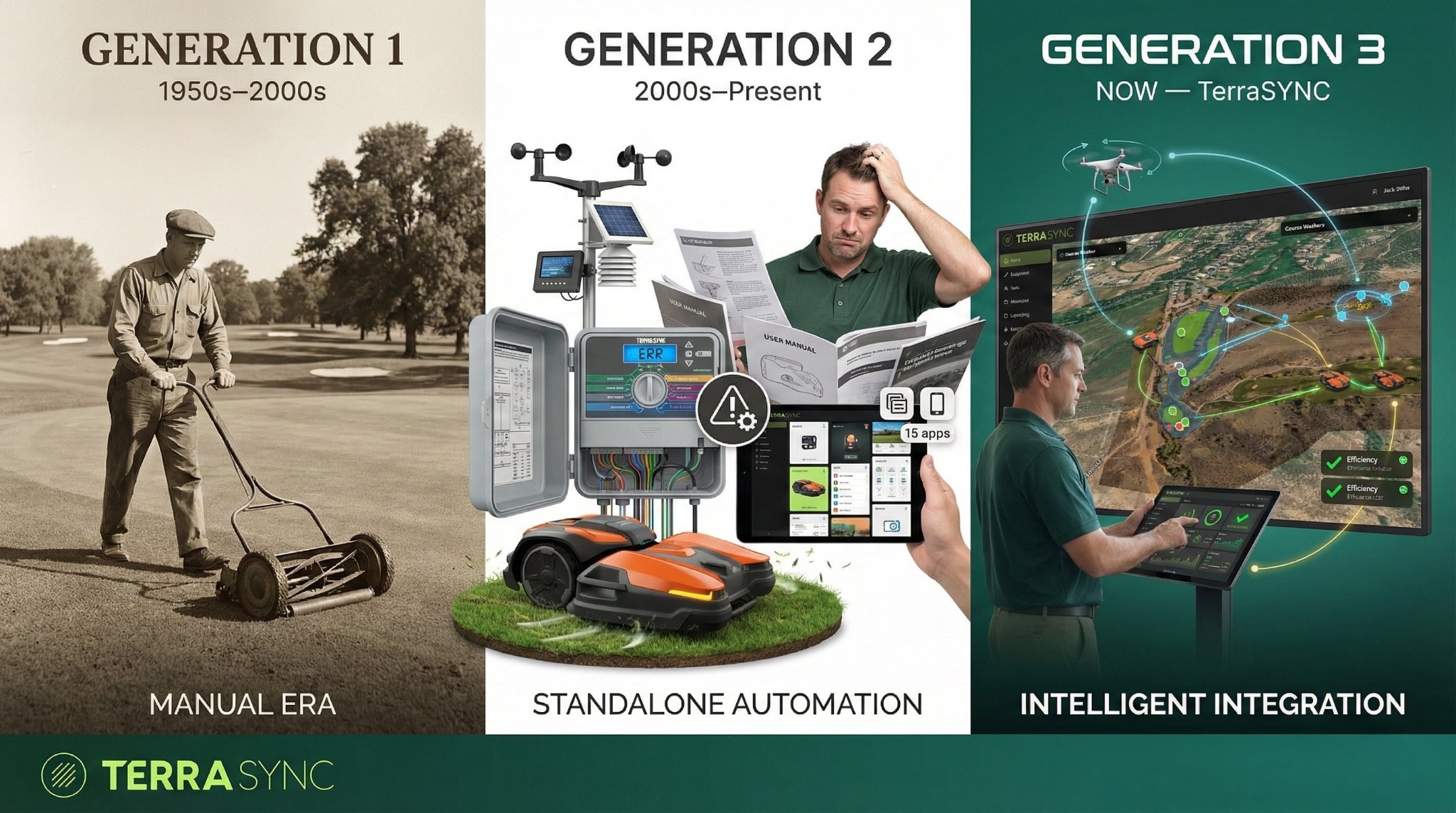
The Three Generations of Grounds Automation
To understand where we're going, we need to understand where we've been.
Generation 1: The Manual Era (1950s–2000s)
For decades, grounds maintenance was entirely labor-driven. Success depended on having enough crew members, the right weather, and a superintendent who could hold it all together through sheer willpower. There was no data. No analytics. No automation. Just people, machines, and long hours.
Generation 2: Standalone Automation (2000s–Present)
Then came the technology wave. Robotic mowers. Smart irrigation controllers. Weather stations. Soil sensors. Drones. GPS tracking. Each innovation promised to make life easier—and each one did, in isolation.
But here's what nobody talked about: every new tool added another app, another login, another support line, another learning curve. Superintendents went from managing people to managing systems—and not in a good way.
"I have 15 different apps on my phone just to run my course. Half of them don't talk to each other. I spend more time logging in than I do actually managing turf."
Sound familiar? That's Generation 2. And most American operations are still stuck there—not because the technology is bad, but because it's disconnected.
Generation 3: Intelligent Integration (Now)
Generation 3 is different. It's not about adding more tools. It's about making the tools you already have work together.
One platform. One dashboard. One support line. Cross-OEM orchestration. Data-aware scheduling. Proactive automation. This is what modern grounds management looks like—and it's available today.
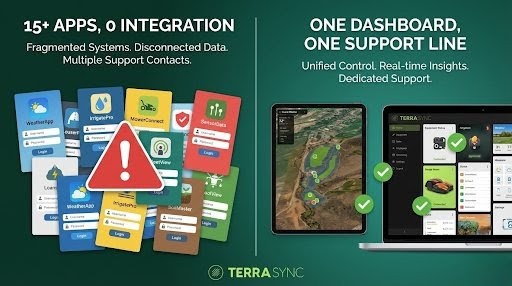
Why Gen 2 Hurts (Even When the Tech Is Good)
Let me be clear: the individual tools in Gen 2 are often excellent. The problem isn't the mower or the irrigation controller. The problem is integration—or the lack of it.
App sprawl creates downtime. When you have 15+ logins and siloed alerts, your reaction time suffers. By the time you've checked three different dashboards, the problem has already escalated.
Support fragmentation kills accountability. Every vendor has its own SLA, its own helpline, its own ticket system. When something goes wrong, you're the one stuck coordinating between them. Nobody owns the whole outcome.
Your superintendent becomes an accidental IT manager. This is the hidden labor cost nobody talks about. The person you hired to manage turf is now spending 30% of their time troubleshooting software, resetting passwords, and explaining to vendors why their system isn't working with someone else's.
Data without decisions is just noise. Gen 2 devices collect mountains of data. But if those systems don't talk to each other, the data just sits there. You have information—but not insight. Numbers—but not action.
The Real Cost
Most superintendents we talk to estimate they lose 5–10 hours per week to system management overhead. That's 250–500 hours per year spent on IT work instead of turf work. What would you do with that time back?
What Gen 3 Looks Like With TerraSync
So what changes when you move to Generation 3? Everything—and nothing.
Everything changes in how your systems work together. Nothing changes in your hardware—because Gen 3 is about integration, not replacement.
One brain, many brands. Husqvarna, Nexmow, Kress. Rain Bird, Hunter, Toro Lynx. Spiio, Soil Scout, Pogo. DJI drones. Manual equipment tracking. Crew scheduling. All of it—managed in one dashboard, regardless of who manufactured it.
Proactive automation. Here's a real example: rain is forecast for 2 PM. In Gen 2, you manually check the weather app, log into the irrigation controller, call the crew to reschedule mowing, and hope you didn't miss anything. In Gen 3? TerraSync automatically pauses irrigation in affected zones, reschedules mowing, notifies your staff, adjusts tomorrow's schedule based on actual rainfall, and logs the decisions for future pattern learning. Zero human intervention required.
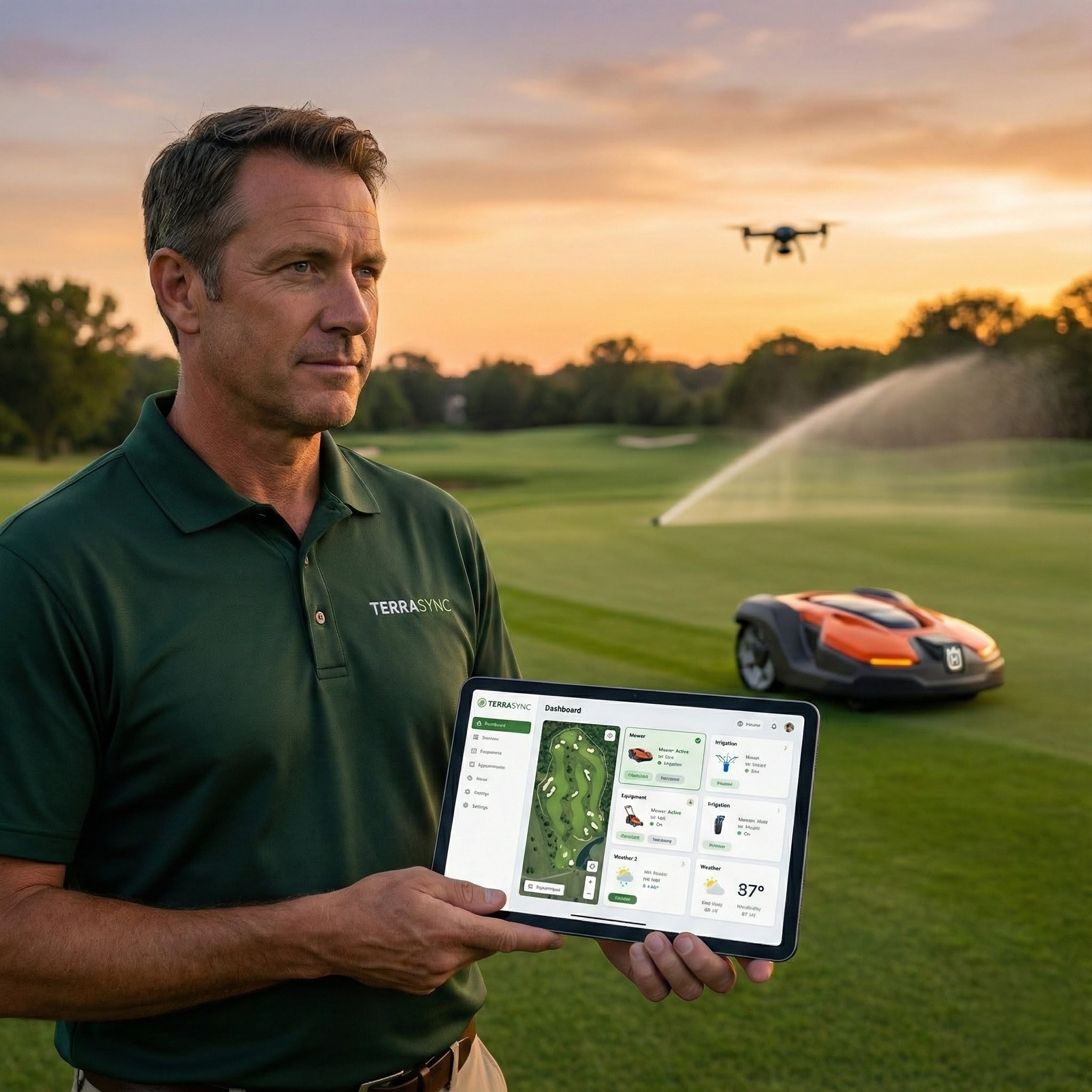
Operational clarity. One pane of glass for assets, schedules, alerts. No more jumping between apps. No more wondering if the mower finished its route or if the irrigation ran last night.
Single support line. This might be the biggest change of all. When something goes wrong, you call one number. One partner. One team that understands your entire ecosystem and owns the outcome—not just their piece of it.
The Business Case (ROI in Plain English)
Let's talk numbers—because at the end of the day, this has to make financial sense.
Labor efficiency. When systems work together, your crew spends less time on reactive firefighting and more time on proactive course improvement. Overtime drops. You can do more with the same headcount—or maintain quality with a smaller team during labor shortages.
Asset uptime. Coordinated schedules mean fewer conflicts. Mowers don't run into irrigation cycles. Equipment gets maintained before it breaks down. The little inefficiencies that add up? They disappear.
Consistency. Automated routines don't have bad days. They don't forget. They don't cut corners when nobody's watching. Data-backed adjustments tighten playing conditions across every hole, every day.
Futureproofing. This is the one most people miss. When you build on an integration layer, you can swap hardware without rebuilding workflows. New mower brand? Plug it in. Better sensor system? Add it to the dashboard. Your investment in Gen 3 infrastructure pays dividends every time you upgrade a single component.
How to Get There (The Simple Path)
Moving from Gen 2 to Gen 3 doesn't require ripping out your existing equipment. Here's the path most of our clients follow:
- Audit your current stack. List every mower, irrigation system, sensor, drone, and app you're currently using. You'll probably be surprised how long the list is.
- Prioritize your pain points. Where are you losing the most time? Downtime? App sprawl? Support chaos? Start there.
- Integrate via TerraSync. Connect your devices, centralize your alerts, set your automation policies. This is where the magic happens.
- Automate the obvious. Weather-triggered changes. Overnight mowing schedules. Irrigation pauses. The stuff that shouldn't require human intervention.
- Measure and iterate. Track labor hours, input costs, surface quality. Use the data to continuously optimize.
Most clients see relief in week one. Not because we've transformed everything overnight, but because the immediate reduction in app-juggling and support calls frees up mental space. The bigger wins compound over months as you dial in your automation policies.
What Superintendents Ask Me First
After hundreds of conversations, I know the questions that come up most. Let me answer them directly.
"Will this work with my existing hardware?"
Yes. Cross-OEM orchestration is the entire point. We're not trying to sell you new mowers—we're trying to make your current mowers work smarter alongside everything else.
"How fast to value?"
Most see tangible relief in week one, once core devices are connected. The full ROI builds over 3–6 months as you optimize automation policies and your team adapts to the new workflow.
"Who supports it when something breaks?"
One TerraSync line. We own the outcome. If the issue is hardware-specific, we coordinate with the vendor on your behalf. If it's integration-related, we fix it directly. Either way, you make one call.
Ready to Move Beyond Gen 2?
Generation 3 is about orchestration, not accumulation. If you're tired of juggling apps and ready for "one platform, one support line," let's talk.
Schedule Your AssessmentGeneration 3 Grounds Automation: Why Integration Beats More Apps
I've spent years watching superintendents juggle 15+ apps just to keep a course playable. The technology exists—but the integration doesn't. Until now. This is the story of how we're moving from Generation 2 to Generation 3, and why it matters for every course operator ready to stop firefighting and start leading.
If you've ever pulled up to work and immediately opened four different apps before your first cup of coffee, you know the problem. One app for the mowers. Another for irrigation. A third for weather. A fourth for scheduling. And that's before we even talk about sensors, drones, or equipment tracking.
Each of these tools, on its own, is impressive. But together? They create chaos. And that chaos has a name: Generation 2.
The Three Generations of Grounds Automation
To understand where we're going, we need to understand where we've been.
Generation 1: The Manual Era (1950s–2000s)
For decades, grounds maintenance was entirely labor-driven. Success depended on having enough crew members, the right weather, and a superintendent who could hold it all together through sheer willpower. There was no data. No analytics. No automation. Just people, machines, and long hours.
Generation 2: Standalone Automation (2000s–Present)
Then came the technology wave. Robotic mowers. Smart irrigation controllers. Weather stations. Soil sensors. Drones. GPS tracking. Each innovation promised to make life easier—and each one did, in isolation.
But here's what nobody talked about: every new tool added another app, another login, another support line, another learning curve. Superintendents went from managing people to managing systems—and not in a good way.
"I have 15 different apps on my phone just to run my course. Half of them don't talk to each other. I spend more time logging in than I do actually managing turf."
Sound familiar? That's Generation 2. And most American operations are still stuck there—not because the technology is bad, but because it's disconnected.
Generation 3: Intelligent Integration (Now)
Generation 3 is different. It's not about adding more tools. It's about making the tools you already have work together.
One platform. One dashboard. One support line. Cross-OEM orchestration. Data-aware scheduling. Proactive automation. This is what modern grounds management looks like—and it's available today.
Why Gen 2 Hurts (Even When the Tech Is Good)
Let me be clear: the individual tools in Gen 2 are often excellent. The problem isn't the mower or the irrigation controller. The problem is integration—or the lack of it.
App sprawl creates downtime. When you have 15+ logins and siloed alerts, your reaction time suffers. By the time you've checked three different dashboards, the problem has already escalated.
Support fragmentation kills accountability. Every vendor has its own SLA, its own helpline, its own ticket system. When something goes wrong, you're the one stuck coordinating between them. Nobody owns the whole outcome.
Your superintendent becomes an accidental IT manager. This is the hidden labor cost nobody talks about. The person you hired to manage turf is now spending 30% of their time troubleshooting software, resetting passwords, and explaining to vendors why their system isn't working with someone else's.
Data without decisions is just noise. Gen 2 devices collect mountains of data. But if those systems don't talk to each other, the data just sits there. You have information—but not insight. Numbers—but not action.
The Real Cost
Most superintendents we talk to estimate they lose 5–10 hours per week to system management overhead. That's 250–500 hours per year spent on IT work instead of turf work. What would you do with that time back?
What Gen 3 Looks Like With TerraSync
So what changes when you move to Generation 3? Everything—and nothing.
Everything changes in how your systems work together. Nothing changes in your hardware—because Gen 3 is about integration, not replacement.
One brain, many brands. Husqvarna, Nexmow, Kress. Rain Bird, Hunter, Toro Lynx. Spiio, Soil Scout, Pogo. DJI drones. Manual equipment tracking. Crew scheduling. All of it—managed in one dashboard, regardless of who manufactured it.
Proactive automation. Here's a real example: rain is forecast for 2 PM. In Gen 2, you manually check the weather app, log into the irrigation controller, call the crew to reschedule mowing, and hope you didn't miss anything. In Gen 3? TerraSync automatically pauses irrigation in affected zones, reschedules mowing, notifies your staff, adjusts tomorrow's schedule based on actual rainfall, and logs the decisions for future pattern learning. Zero human intervention required.
Operational clarity. One pane of glass for assets, schedules, alerts. No more jumping between apps. No more wondering if the mower finished its route or if the irrigation ran last night.
Single support line. This might be the biggest change of all. When something goes wrong, you call one number. One partner. One team that understands your entire ecosystem and owns the outcome—not just their piece of it.
The Business Case (ROI in Plain English)
Let's talk numbers—because at the end of the day, this has to make financial sense.
Labor efficiency. When systems work together, your crew spends less time on reactive firefighting and more time on proactive course improvement. Overtime drops. You can do more with the same headcount—or maintain quality with a smaller team during labor shortages.
Asset uptime. Coordinated schedules mean fewer conflicts. Mowers don't run into irrigation cycles. Equipment gets maintained before it breaks down. The little inefficiencies that add up? They disappear.
Consistency. Automated routines don't have bad days. They don't forget. They don't cut corners when nobody's watching. Data-backed adjustments tighten playing conditions across every hole, every day.
Futureproofing. This is the one most people miss. When you build on an integration layer, you can swap hardware without rebuilding workflows. New mower brand? Plug it in. Better sensor system? Add it to the dashboard. Your investment in Gen 3 infrastructure pays dividends every time you upgrade a single component.
How to Get There (The Simple Path)
Moving from Gen 2 to Gen 3 doesn't require ripping out your existing equipment. Here's the path most of our clients follow:
- Audit your current stack. List every mower, irrigation system, sensor, drone, and app you're currently using. You'll probably be surprised how long the list is.
- Prioritize your pain points. Where are you losing the most time? Downtime? App sprawl? Support chaos? Start there.
- Integrate via TerraSync. Connect your devices, centralize your alerts, set your automation policies. This is where the magic happens.
- Automate the obvious. Weather-triggered changes. Overnight mowing schedules. Irrigation pauses. The stuff that shouldn't require human intervention.
- Measure and iterate. Track labor hours, input costs, surface quality. Use the data to continuously optimize.
Most clients see relief in week one. Not because we've transformed everything overnight, but because the immediate reduction in app-juggling and support calls frees up mental space. The bigger wins compound over months as you dial in your automation policies.
What Superintendents Ask Me First
After hundreds of conversations, I know the questions that come up most. Let me answer them directly.
"Will this work with my existing hardware?"
Yes. Cross-OEM orchestration is the entire point. We're not trying to sell you new mowers—we're trying to make your current mowers work smarter alongside everything else.
"How fast to value?"
Most see tangible relief in week one, once core devices are connected. The full ROI builds over 3–6 months as you optimize automation policies and your team adapts to the new workflow.
"Who supports it when something breaks?"
One TerraSync line. We own the outcome. If the issue is hardware-specific, we coordinate with the vendor on your behalf. If it's integration-related, we fix it directly. Either way, you make one call.
Ready to Move Beyond Gen 2?
Generation 3 is about orchestration, not accumulation. If you're tired of juggling apps and ready for "one platform, one support line," let's talk.
Schedule Your AssessmentStart writing here...