
Mowing gets most of the attention in grounds automation, but it is not the only repetitive job on a course or a sports complex. Someone picks the range every day, rakes the bunkers before play, and repaints the lines on every field, and robots now exist for each of these jobs. This guide covers what they do, what they need from your staff, and where they don't fit.
The jobs that aren't mowing
Three kinds of machine matter here:
- Range pickers, which tow ball-collecting gangs across a driving range on a set path.
- Bunker rakes, which rake sand bunkers so the crew doesn't have to do every one by hand.
- Line painters, which mark sports fields from a stored layout.
All three use satellite positioning rather than buried wire, and all three run on batteries. None of them runs without people. They take the repetitive part of the job, and your staff handle the hand-offs, the exceptions and the finish work. On the golf side we work with Korechi, whose golf line covers range picking and bunker raking.
Range pickers: how the Pik'r works
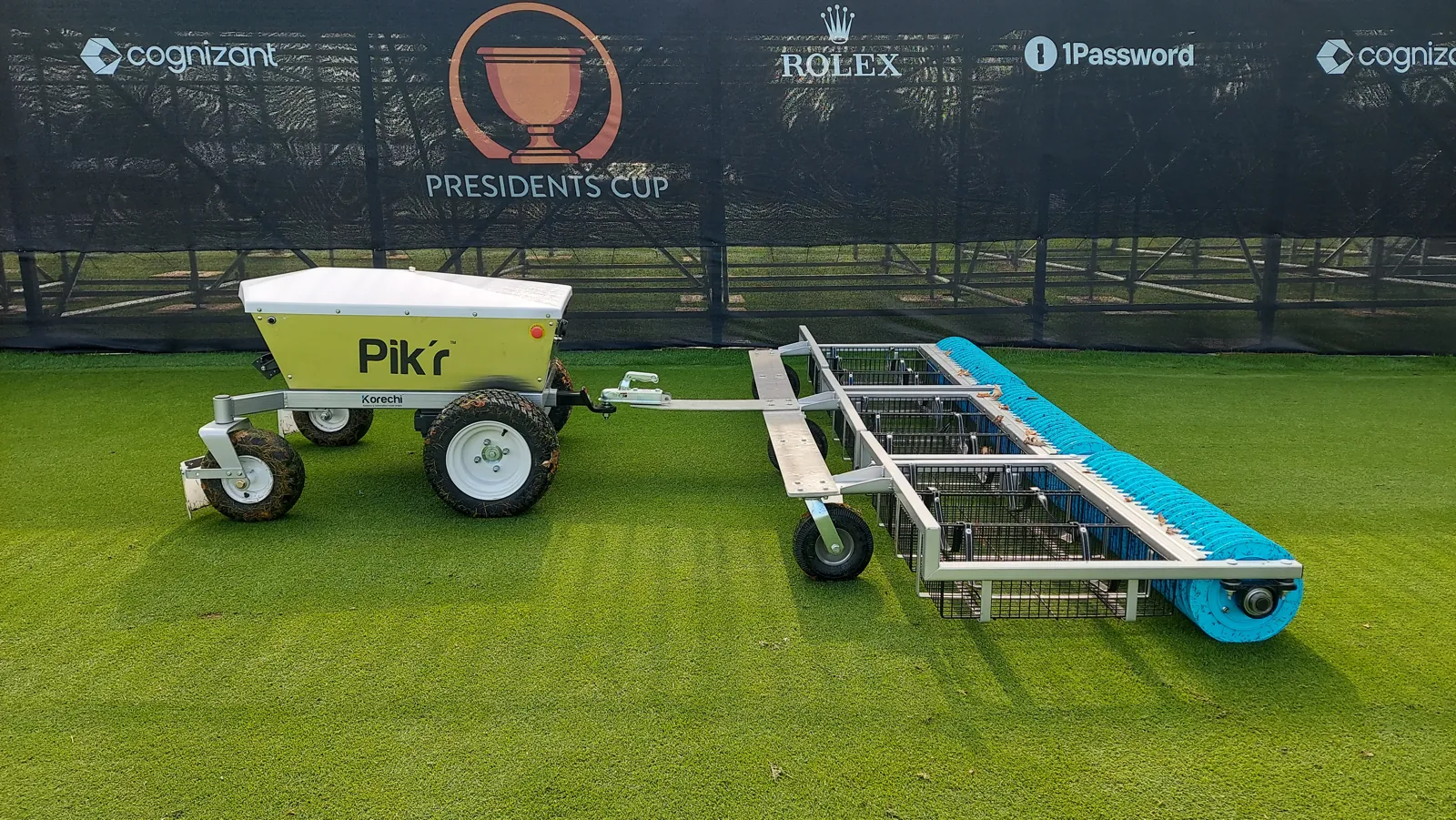
A range picker is a small autonomous tractor pulling one or more picking gangs. Each Korechi gang is 43 inches wide and carries three stainless-steel baskets holding up to 400 balls each, so 1,200 balls per gang. An optional automatic ball-dumping setup raises that to 1,500 per gang.
Korechi builds two current machines:
- Pik'r-X. Works with up to three gangs. Korechi rates it at up to 6.2 acres per hour and up to 3,600 balls per circuit with three gangs, with up to 12 hours of continuous run time.
- Pik'r-XL. Works with five gangs for up to 6,000 balls per circuit and up to 10.4 acres per hour, with up to 18 hours of run time. Korechi positions it for large ranges of 5 to 20 acres handling 20,000 to 150,000 balls per day.
Both top out at 4.8 mph and navigate with multi-band GNSS RTK and a dual antenna. For obstacles, Korechi lists four cameras, one on each side, plus a LiDAR on the front.
In practice the robot runs a mapped path across the range and fills its baskets. When they are full it returns to its home position to be emptied. Korechi says emptying by hand takes under two minutes, and about one minute with auto-dump on the models that have it. When the battery runs low, the robot returns home and alerts range staff. A full charge takes 4 to 8 hours, depending on the model and how far down the battery is. Staff can watch the robot and send it on any path from Korechi's Pik'r Connect phone app.
Coverage scales with the number of gangs. Korechi rates one gang at 2.1 acres per hour, three at 6.2 and five at 10.4. Here is how that reads on a real range. Take a 10-acre range and a Pik'r-X pulling three gangs. On paper, one full pass takes a little over an hour and a half, plus a stop to empty whenever the baskets fill at 3,600 balls. Real time will be longer around targets, bunkers and slopes, so treat the rating as a ceiling rather than a promise.
Bunker raking: the Raek'r
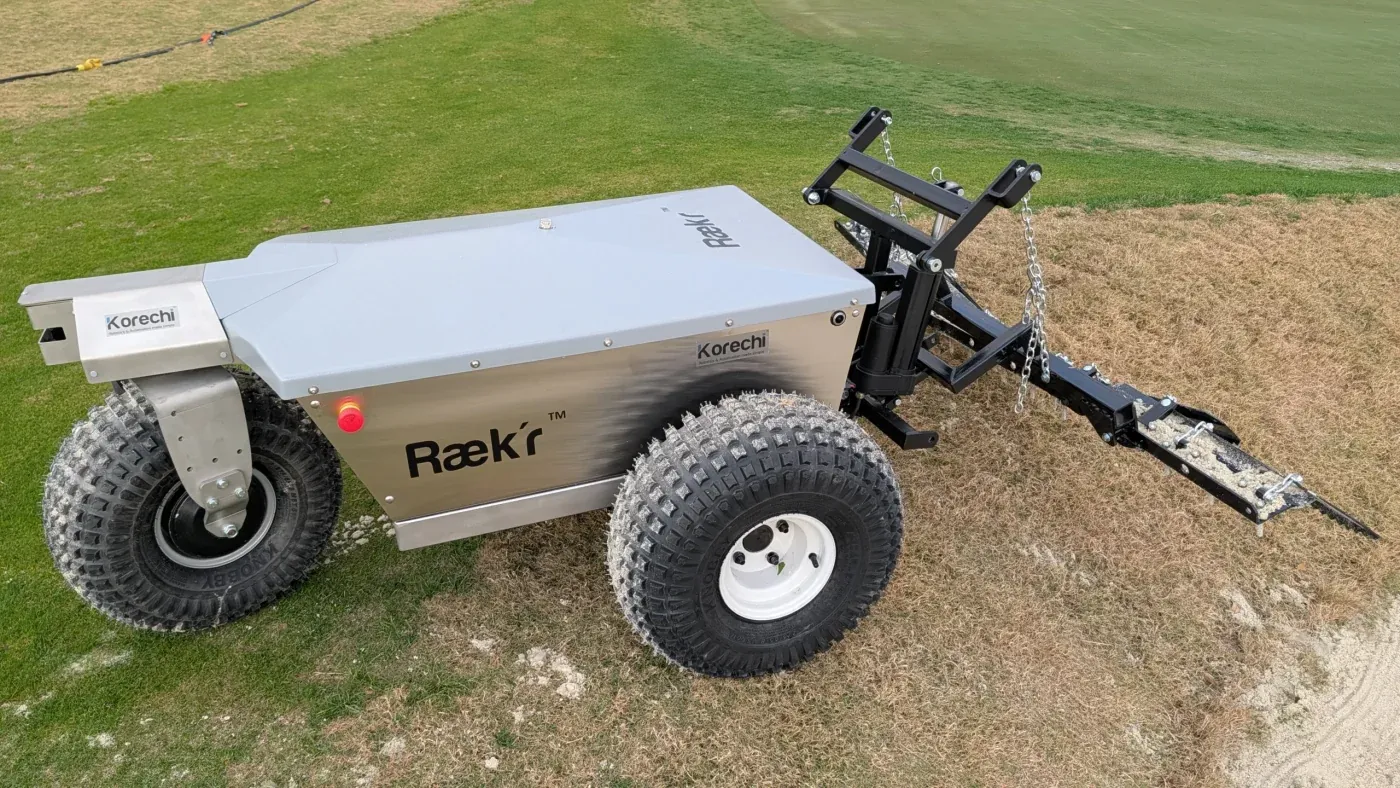
Bunker raking is slow, repetitive hand work. The Korechi Raek'r is built to take the routine raking. Korechi lists up to 20 hours of continuous runtime and an 8-hour charge from a standard wall outlet. It drives at up to 6 mph and uses a 16.3 kWh, 48 V lithium iron phosphate battery. It has three-wheel drive for traction on soft sand and all stainless-steel construction, and the base unit weighs 700 lb. The warranty is two years on the machine and five years on the battery.
It needs no perimeter wire, and Korechi says it works with multiple raking attachments, including rakes you already own. Scheduling, commands and monitoring run from a phone app.
Korechi's published material does not say much about how the Raek'r handles steep faces, lips or the route between bunkers. Those details decide whether it suits your course, so ask to see it work on your hardest bunkers before you commit.
Line painters for sports fields
GPS-guided line-marking robots are an established category from several makers, including Turf Tank and TinyMobileRobots. Instead of measuring out a field with string and tape, a crew stores the layout once. The robot then paints it using high-precision positioning and can repaint the same lines in the same place each time.
The payoff is in how often fields get marked. Schools, parks departments and clubs repaint football, soccer and lacrosse fields through the season, and a robot turns the measuring and walking into a setup and a check. Staff still fill paint, move the robot between fields, and check the result before games.
When you compare makers, look at the sports and layouts each one supports, how much paint it uses, and who services it in your area. We can include field marking in a property plan alongside mowing and range work.
What it takes to run them
Mapping
Each machine works from a map of your property. For the Pik'r, Korechi says the range and its obstacles are mapped with input from your staff: where balls collect, which areas to avoid, and anything unusual about the site. A trained dealer or Korechi representative does the installation. That input matters. The staff who pick the range today know where the balls actually land.
Charging and home positions
Pickers and rakes need a home position with power nearby, out of the way of play. Charge times are long enough to plan around: 4 to 8 hours for a Pik'r and 8 hours for the Raek'r. Confirm whether charging at your site is automatic or a staff task, and where the machine will sit while it charges.
Staff hand-offs and routines
The robot collects the balls. People still empty them into the ball washer, stock the dispenser, and decide when picking runs around open hours. Bunker robots handle routine raking, but expect staff to handle faces, edges and washouts after heavy rain. Write the routine down before the machine arrives: who empties, who checks, and who gets the low-battery alert.
We cover the physical side, like placement, power and commissioning, as part of installation.
Where they fit, and questions to ask
These machines make the most sense where the job repeats every day at volume: busy driving ranges and practice facilities, courses with many bunkers, and complexes with several fields to mark. They make less sense on a small range picked in a few minutes, on bunkers with steep faces the machine can't work, or where there is no safe place to park and charge.
For sports fields, the test is simple: count how many fields you mark, how often, and how long each one takes today. A single field marked a few times a season is easy to keep by hand. A complex with several fields relined every week is where a painter earns its place.
- How many balls does your range go through on a busy day, and how many acres is it? Match that to the machine's rated circuit capacity and acres per hour.
- When will it pick? Does the manufacturer support picking while golfers are hitting, and with what protection?
- Where does it go home, and who empties and charges it?
- For bunker rakes: how does it enter and leave a bunker, and what does it do on the face and lip?
- Does repeated traffic between bunkers wear the surrounds?
- Who services it locally, and how quickly?
- What does the app show, and who on your staff will watch it?
FAQ
Can a range picker run while golfers are hitting?
Korechi's product pages don't state an operating policy for live hitting, so settle this with the manufacturer and your own safety rules before you schedule it. Picking before opening and after close is always an option.
Does a bunker robot replace the crew?
No. It takes the routine raking. People still handle faces, edges, storm damage and anything the machine can't reach.
Do these machines need boundary wire?
No. The Pik'r uses GNSS RTK positioning, and Korechi states the Raek'r needs no perimeter wire.
Can the same robot mow?
The Pik'r and Raek'r are sold for picking and raking. For mowing, see how robotic mowing works on large properties and our golf course guide. For the full machine specs, see our Korechi page.