
Most turf programs still apply product the way they always have: a full pass over a whole fairway or lawn, whether every square foot needs it or not. Spray drones and GPS-guided sprayers promise to put product only where the map says it belongs. That can be a real change, but it arrives with more rules, not fewer, and the machines do not take the legal responsibility off anyone's shoulders.
What precision application means
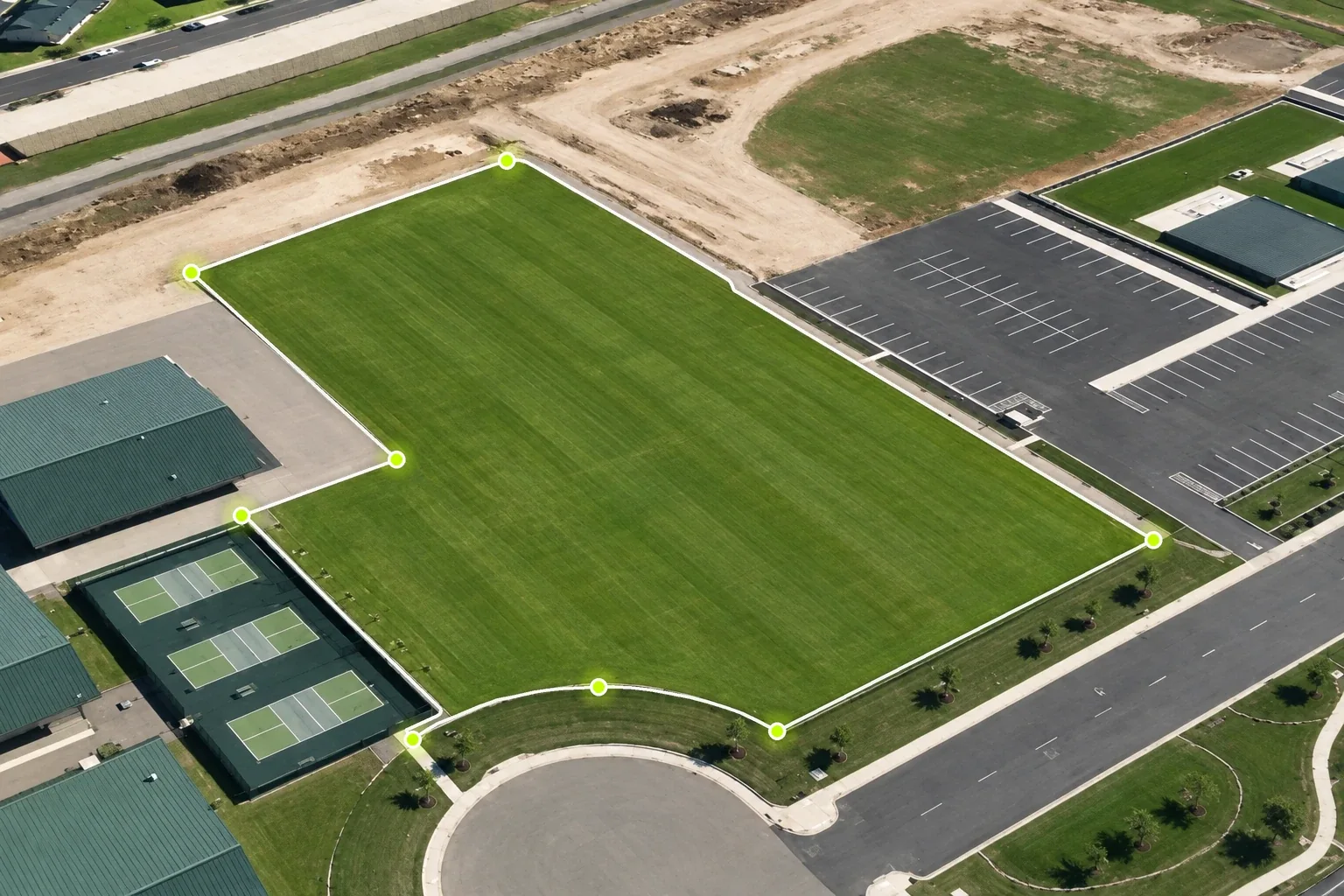
Precision application means applying by map instead of by habit. You decide which zones need a product, at what rate, and which areas must stay untouched, then the machine follows that map. A blanket pass treats the whole property the same. A precision plan treats the fifth fairway's weed pressure differently from the clean one next to it, and never sprays the pond edge, the playground or the landscape bed.
Three things have to be true for that to work:
- An accurate map. Boundaries, water, beds, buildings and other stay-out areas drawn where they really are.
- Accurate positioning. RTK GPS corrects satellite positions against a fixed base station, which is what lets a machine know where it is to within a few centimeters instead of a few meters.
- A decision about what each zone needs. That is agronomy, and it stays with your superintendent or licensed applicator.
The first piece is familiar if you already run robotic mowers. The zone map we build in Velocity for mowing already marks water, landscape beds, buildings, pavement and other exclusions. A precision application plan starts from the same kind of map. The product choice, the rate and the timing do not come from software.
The machines: spray drones and ground sprayers
Spray drones
Spray drones are large multirotor aircraft with a liquid tank, pumps and nozzles, and in most cases a spreading kit for granules. The best-known line is DJI's Agras series. Two current models, from DJI's published specifications:
| Spec (DJI published) | Agras T25 | Agras T50 |
|---|---|---|
| Spray tank | 20 L (about 5.3 gal) | 40 L (about 10.6 gal) |
| Weight with battery, empty tank | 32 kg (about 71 lb) | 52 kg (about 115 lb) |
| Max takeoff weight, spraying | 52 kg | 92 kg |
| Effective spray width at 3 m above the crop | 4–7 m | 4–11 m |
| Max wind resistance | 6 m/s (about 13 mph) | 6 m/s (about 13 mph) |
A few things in that table matter for a grounds team. DJI lists payload figures at sea level and says they drop as altitude rises. The spray widths are measured over crops, not turf, and DJI notes they depend on the job. Both models use radar for terrain following and obstacle sensing, and DJI lists hover accuracy of about 10 cm with RTK enabled. And both weigh more than 55 pounds with the battery in, before any product goes in the tank. That puts them in the FAA's heavier category, covered below.
One more check for 2026: in December 2025 the FCC added foreign-produced drones and critical drone components to its Covered List. The FCC says this applies to new models, not to models it had already authorized. Ask any supplier whether the exact model you are considering is authorized for US sale, and how parts and support will work.
Ground-based GPS-guided and autonomous sprayers
The other category stays on the ground. GPS-guided turf sprayers use positioning to steer and to switch boom sections or individual nozzles on and off, so they skip areas already sprayed and areas marked out of bounds. Fully autonomous sprayers drive a programmed route on their own. Both avoid most of the aviation rules, carry product close to the turf, and fit the way turf crews already work. Their limits are physical: steep slopes, soft or wet ground, tight spaces and obstacles. We describe this category qualitatively on purpose. Claims about product savings vary by machine, site and program, and we would rather you ask a maker for measured results from a site like yours.
The licensing reality
Autonomy does not change who is legally responsible for an application. Three layers of rules apply, and they stack.
State applicator certification
Federal law requires anyone who applies or supervises the use of restricted use pesticides to be certified under EPA rules and state, territorial or tribal law. States run that certification, and you must be certified in each state where you apply. Many states go further and require all commercial applicators to be certified, not only those using restricted products. EPA's 2017 revision of the certification rule added a specialized certification for applying restricted use pesticides by air. Your state pesticide agency is the place to confirm what applies to your team.
The label is the law
Every pesticide label carries the statement: "It is a violation of Federal law to use this product in a manner inconsistent with its labeling." The label sets the sites, rates, application methods, protective equipment and restrictions. If a label does not allow aerial application, a spray drone is not an option for that product, however precise it is.
FAA rules for aerial application
Dispensing pesticides from any aircraft, including a drone, is an agricultural aircraft operation under 14 CFR Part 137. So is dispensing any substance intended for plant nourishment, soil treatment, propagation of plant life or pest control, which covers fertilizer as well. The operator needs a Part 137 certificate, a Remote Pilot Certificate, a registered aircraft and FAA exemptions. Drones under 55 pounds, counting the load, fly under Part 107 with exemptions; drones of 55 pounds or more fly under Parts 91 and 137 with exemptions under 49 U.S.C. 44807. The FAA asks for exemption petitions at least 120 days ahead. Our guide to drones for grounds teams covers the Part 107 basics.
Drift, weather and buffers
EPA defines spray drift as pesticide droplets or dust moving through the air, during or soon after application, to anywhere other than the intended area. Drift can reach homes, schools, playgrounds, workers and water. On a golf course or campus, those are often right next door.
The factors are well known: droplet size, release height, wind speed and direction, and temperature inversions, when cool air near the ground traps small droplets and lets them move unpredictably. Spray drones add rotor downwash and a higher release point than a ground boom. DJI's nozzles can be set to a range of droplet sizes, from very coarse to extremely fine, and that setting matters.
The label is the first source for wind limits, droplet size and buffers, so read it before every job. Keep buffers around ponds, streams, storm drains and anything off the property. Check the forecast for rain and wind before you start, and be ready to stop midway. A precise machine still drifts in the wrong conditions.
Plan the stay-outs first
Before anyone loads a tank, walk the map: water, drains, beds, play areas, property lines. If a zone is not clearly inside the plan, it is outside it.
Records, and where people stay responsible
A machine that applies by map produces a natural record: where it went, when, and at what settings. That is useful, but it is not the legal record. Your state pesticide agency sets which records a licensed applicator must keep and for how long. Keep the product, rate, area, date, time, weather and applicator name in the format your state expects, and keep the machine's log alongside it.
People remain responsible for every decision that matters:
- Choosing the product and rate, and confirming the label allows the method.
- Mixing, loading and cleaning, which are the most hands-on steps.
- Calibrating the machine and checking it is putting down what it should.
- Deciding whether today's weather is safe, and stopping when it changes.
- Clearing people from the area and keeping them off until the label allows.
How to evaluate: questions to ask
Whether you buy a machine or hire an operator, ask:
- Who holds the state applicator certification, including any aerial certification, and who supervises on site?
- For a drone: who holds the Part 137 certificate and the FAA exemption, and does it cover our location?
- Do the labels for the products we use allow this application method?
- How is the application map built, and who approves the stay-out areas before the first job?
- What wind, weather and buffer limits does the operator use, and who calls a stop?
- What records does the machine produce, and do they meet our state's requirements?
- Is this exact model authorized for US sale, and where do parts and service come from?
- Can you show measured results from a site like ours, not a brochure?
If the answers are thin, start smaller. Mapping the property properly is useful even before any product moves. Our consulting work starts there.
FAQ
Can our assistant superintendent fly a spray drone with a Part 107 certificate?
Not on that alone. Aerial application also needs a Part 137 certificate, FAA exemptions and the state pesticide certification that applies to the work.
Does spreading fertilizer by drone count as aerial application?
Yes. Part 137 covers substances intended for plant nourishment and soil treatment, not only pesticides.
Will precision application cut our chemical use?
It can reduce product if large parts of your property do not need treatment, but we will not quote a number. Ask for measured results from comparable sites.
Is a ground sprayer simpler than a drone?
From a rules standpoint, usually. It avoids FAA aviation rules, though state licensing and the label still apply in full.