
One robotic mower on a small lawn is simple, but twenty acres of rough, a campus with forty separate lawns, or an estate with a steep bank is a different job. The question stops being whether a robot can cut grass and becomes how many machines you need, where they charge, what happens when it rains, and who still has work to do. This guide walks through how robotic mowing works at that scale.
What robotic mowing looks like on a large property
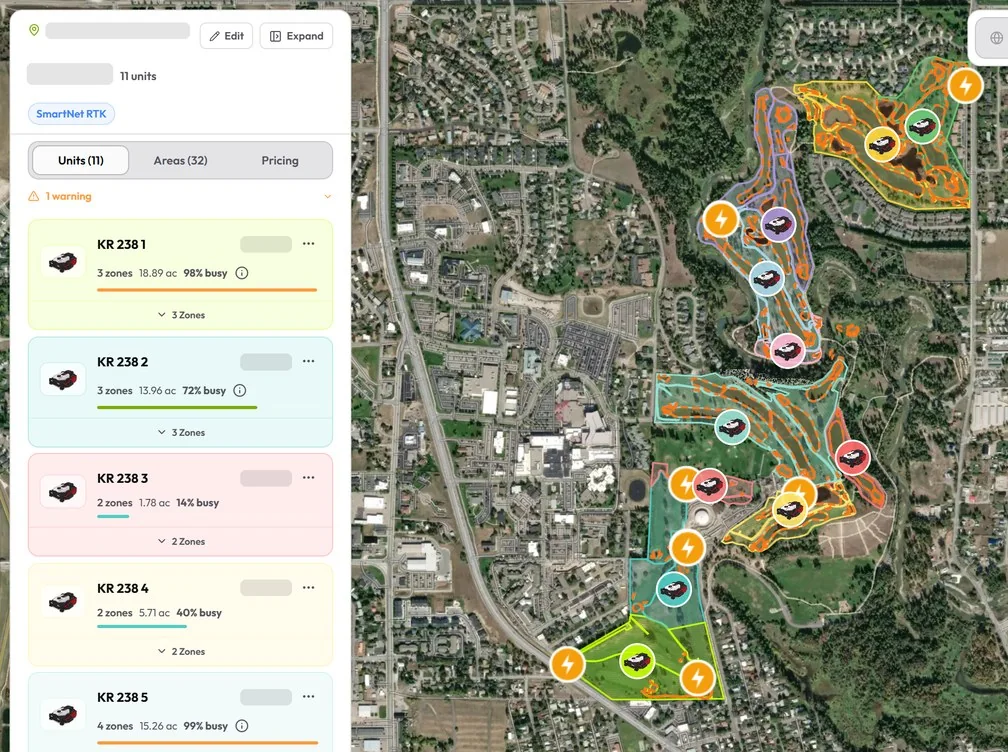
On a big site, robotic mowing is a fleet, not a gadget. Several battery-powered mowers each own a set of mapped areas. They cut on a schedule, return to a charging station on their own, and report where they are. A crew still finishes the edges, the tight corners and anything too steep or too small for a machine.
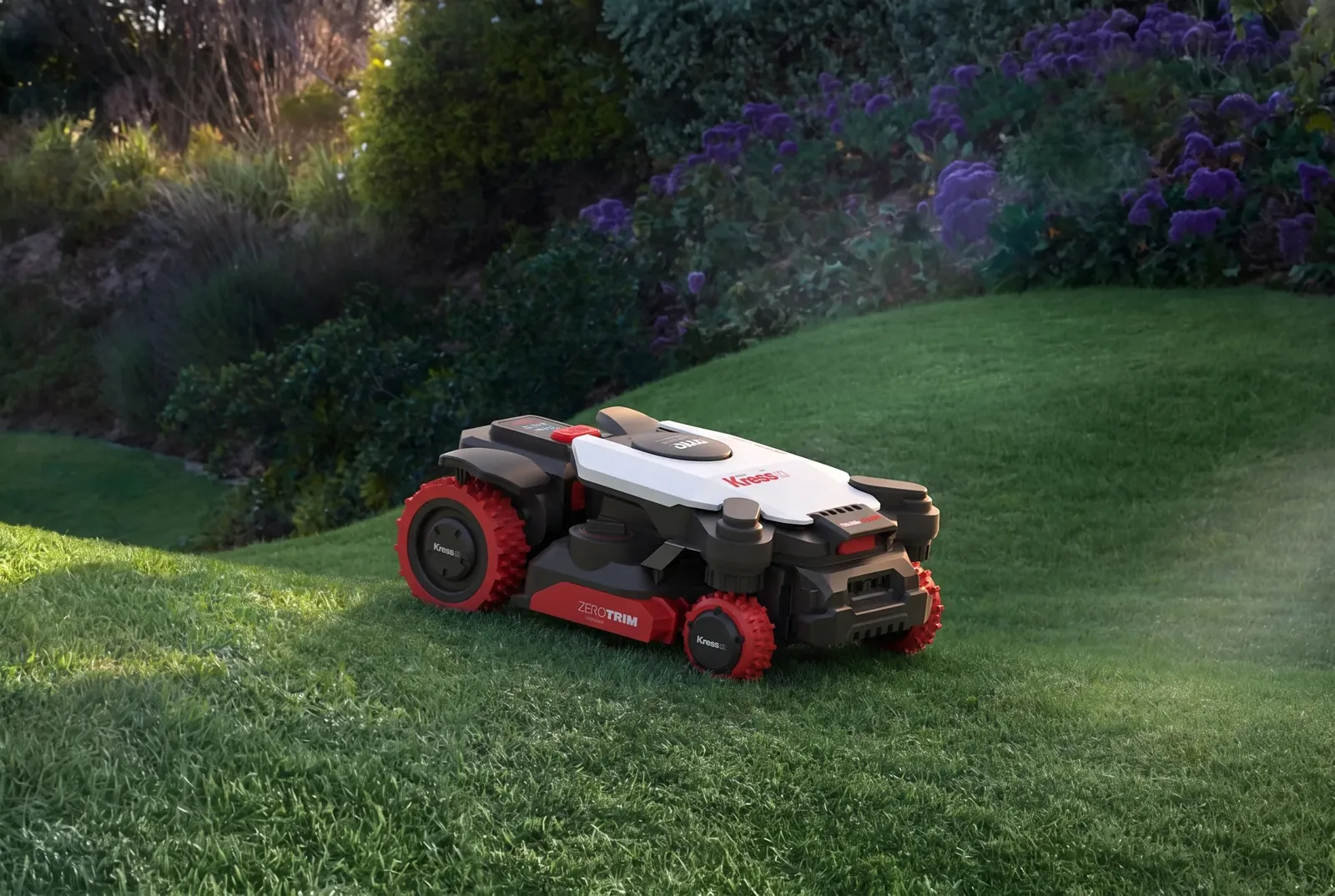
The machines range widely. At one end are compact units cutting roughly 9 to 14 inches wide, such as the Kress RTKⁿ and EyePilot models and the Husqvarna Automower EPOS line. At the other end are larger commercial machines such as the Husqvarna CEORA, with a 26.8-inch cut, and the Kress Voyager KR800, with a 40-inch deck. NEXMOW's M1, M1S and M2 sit in between, with a 13.8-inch cut, and NEXMOW sells them to run as fleets of two to ten units per zone.
How the mowers find their way: RTK instead of wire
Older robotic mowers follow a boundary wire, a low-voltage cable laid around each area. The mower senses the signal and turns back at the edge. It works, but every change to a bed or path means moving wire, and aeration or trenching can cut it. On a large property that is a lot of wire to keep intact.
Most commercial machines now use RTK satellite positioning instead. Plain GPS is accurate to a few meters. RTK corrects it with data from a fixed reference point, either a base station on or near the site or a correction network, and brings accuracy down to centimeters. Husqvarna states about 2 cm for its EPOS system. Kress states centimeter-level accuracy for its RTKⁿ mowers without property-specific stationary antennas.
With RTK, boundaries are drawn on a map, not buried. Changing a zone is an edit, not a dig. NEXMOW describes the same idea: zones are geofenced once in the app instead of trenched as wire.
RTK has a limit worth knowing. It needs a clear view of the sky, so heavy tree canopy and tall buildings can weaken the signal. That is one reason newer machines add cameras and other sensors. Kress pairs RTKⁿ with vision on its EyePilot models, and lists a 360° camera, 360° ultrasonic sensors and a front LiDAR on the Voyager KR800.
Zones, schedules and slopes
A zone is an area mowed as one unit, with its own cutting height and cadence. A golf course might have separate zones for fairways, rough and tees. A campus might split its main quad from the lawns behind each building. In Velocity, our planning software, the starting defaults are four cuts a week for fairways with a 16-hour cap on any single session, and two and a half cuts a week for rough and general turf with a 24-hour cap. Both are adjusted per property.
Cutting height narrows the choice of machine. The Husqvarna Automower 580L EPOS cuts down to 0.4 inches for golf and sports turf. The Automower 550H EPOS cuts 2 to 3.6 inches, which suits warm-season turf. The Voyager KR800 ranges from 1.5 to 5.0 inches.
Slope is the other hard filter. Manufacturers rate it in percent: 100% is a 45° bank, and 84% is about 40°.
| Machine | Maximum slope (manufacturer rating) |
|---|---|
| Kress EyePilot 4×4 (KR282, KR284, KR286) | 84% |
| Husqvarna Automower 535 AWD EPOS | 70% inside the area, 50% at the boundary |
| Husqvarna Automower 560 EPOS | 50% inside the area, 20% at the boundary |
| Husqvarna Automower 580 EPOS | 45% inside the area, 20% at the boundary |
| NEXMOW M1S | 45% (25°) |
| Kress RTKⁿ (KR233, KR236S, KR237) and Voyager KR800 | 40% |
| NEXMOW M1 | 25% |
Note the boundary figures. Husqvarna rates its machines for less slope at the edge of a zone than inside it. A bank that runs right up to a boundary has to meet the lower number. When we plan in Velocity, any zone steeper than the standard 40% rating can only go to a four-wheel-drive model.
How many mowers a property needs
Acreage is the start, not the answer. Five things drive the count:
- Acres of turf that a machine can actually reach.
- How often each zone is cut. Cutting daily needs roughly twice the machine time of cutting every other day.
- Zone shape. Long, narrow or jagged areas mean more turning and less cutting. Trees slow a mower down too.
- Slope, which limits which models qualify and how fast they work.
- Cutting height and turf, which rule some models out entirely.
Manufacturers state capacity over a time window, and the window matters. Kress rates the KR237 at 7 acres when cutting every 48 hours and 10.5 acres when cutting every 72 hours. Husqvarna rates the Automower 580 EPOS at 4 acres on its standard 48-hour setting and 2 acres on its 24-hour sports setting. So 12 acres of open rough cut every other day works out to about three 580-class machines on paper. Cut it daily and the count doubles, before shape or slope take anything away.
Velocity does this properly, zone by zone. It measures each zone's area and perimeter from the map and adjusts each mower's rated speed for shape and slope. It counts treed areas at 62% of the open rate. Then it checks the weekly mowing hours against the schedule you set. It plans each mower to at most 85% of the 168 hours in a week, which leaves room for charging, interruptions, weather and service. It then recommends the fewest practical machines and splits large zones into mower-sized territories.
It also says plainly what the machines won't do. In Velocity's analysis, a zone smaller than a quarter acre or narrower than 16 feet stays with the crew. The result shows how many acres the machines cover and how many the crew finishes. We measure that split rather than guess at your crew's hours.
Running it: charging, weather, security and people
Charging and power
Each mower drives back to its charging station when the battery runs low. Stations need power run to them, and where they sit matters, because every trip across the property is time not cutting. Charge times vary a lot by class. Husqvarna lists about 120 minutes of mowing and 55 minutes of charging for the Automower 580 EPOS. Kress lists a 10 kWh battery and a 9-hour charge for the Voyager KR800. Placing stations and running power is a large part of installation planning.
Weather and rain
These machines are built to live outside. The Kress RTKⁿ models are rated IPX5 and the EyePilot models IPX6. Being waterproof is not the same as being a good idea to run, though. Mowing saturated turf can rut soft ground, and frosted turf should not be cut. Schedules need a rule for holding after heavy rain. That is part of why Velocity plans with spare capacity.
Security
A mower left out overnight is an obvious concern. Connected machines report their position, and Kress lists integrated 4G and premium security on its EyePilot 4×4 models. Ask what each model offers, such as a PIN lock, an alarm and location tracking, and check how your insurer treats equipment left outdoors.
People
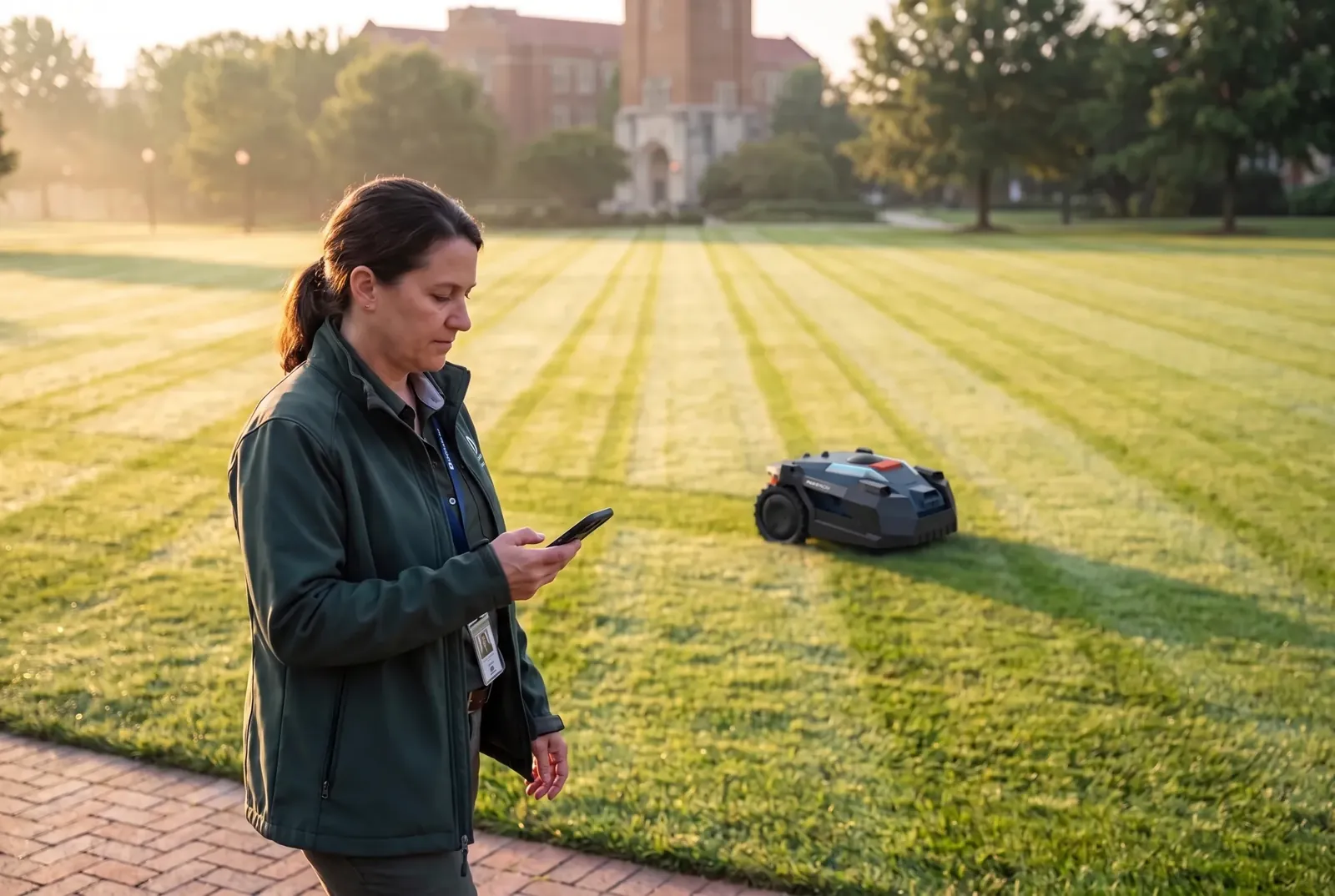
Robots take the large, repetitive acres. People still trim around beds, trees, posts and walls. Kress's EyePilot models add ZeroTrim edge cutting, which narrows the leftover strip but doesn't remove it. People also mow the zones the machines can't reach, clear branches after a storm, and keep an eye on the fleet. Servicing covers blades, sensor cleaning, software updates and seasonal cadence changes. When we install, we set up the RTK base station where the system uses one, commission the machines and run the first season alongside your crew.
Questions to ask before you commit
- How many acres will the machines cover, and how many stay with the crew? Ask for the split in acres, zone by zone.
- What cutting frequency and schedule window was the fleet sized for? Does it match what your turf needs in peak season?
- Which zones exceed the slope rating, both inside the area and at the boundary?
- Where will each charging station sit, and what electrical work is needed to get power there?
- How do boundaries get changed when a bed, path or event layout changes?
- What anti-theft and tracking features does each model have?
- Who services the machines, how often, and what happens when one is down?
For sector detail, see our golf course guide and our commercial property guide.
FAQ
Can robotic mowers cut golf fairways?
Some can. You need a machine rated for low cutting heights and fine turf, such as the Husqvarna Automower 580L EPOS, which cuts down to 0.4 inches, or the Kress KR237, which goes down to 0.39 inches. Greens are a different job and are not covered here.
Do they mow while people are around?
They have obstacle detection, but they are still machines with spinning blades. We schedule them for nights or quiet hours where we can, and time zones near busy areas around use.
Can we start with part of the property?
Yes. Velocity can plan a phased rollout, account for machines you already own, and compare scenarios side by side. You can start with the largest open areas and add zones once the first season has run.
What about the other jobs on a golf course?
Range picking and bunker raking can be automated too. See our guide to autonomous course equipment.