

Soil sensors and smart irrigation: watering by data, not by timer
What in-ground sensors measure, where to put them, how smart controllers use the readings, and what it takes to keep the system accurate.
Sep 28, 2026 · 8 min read
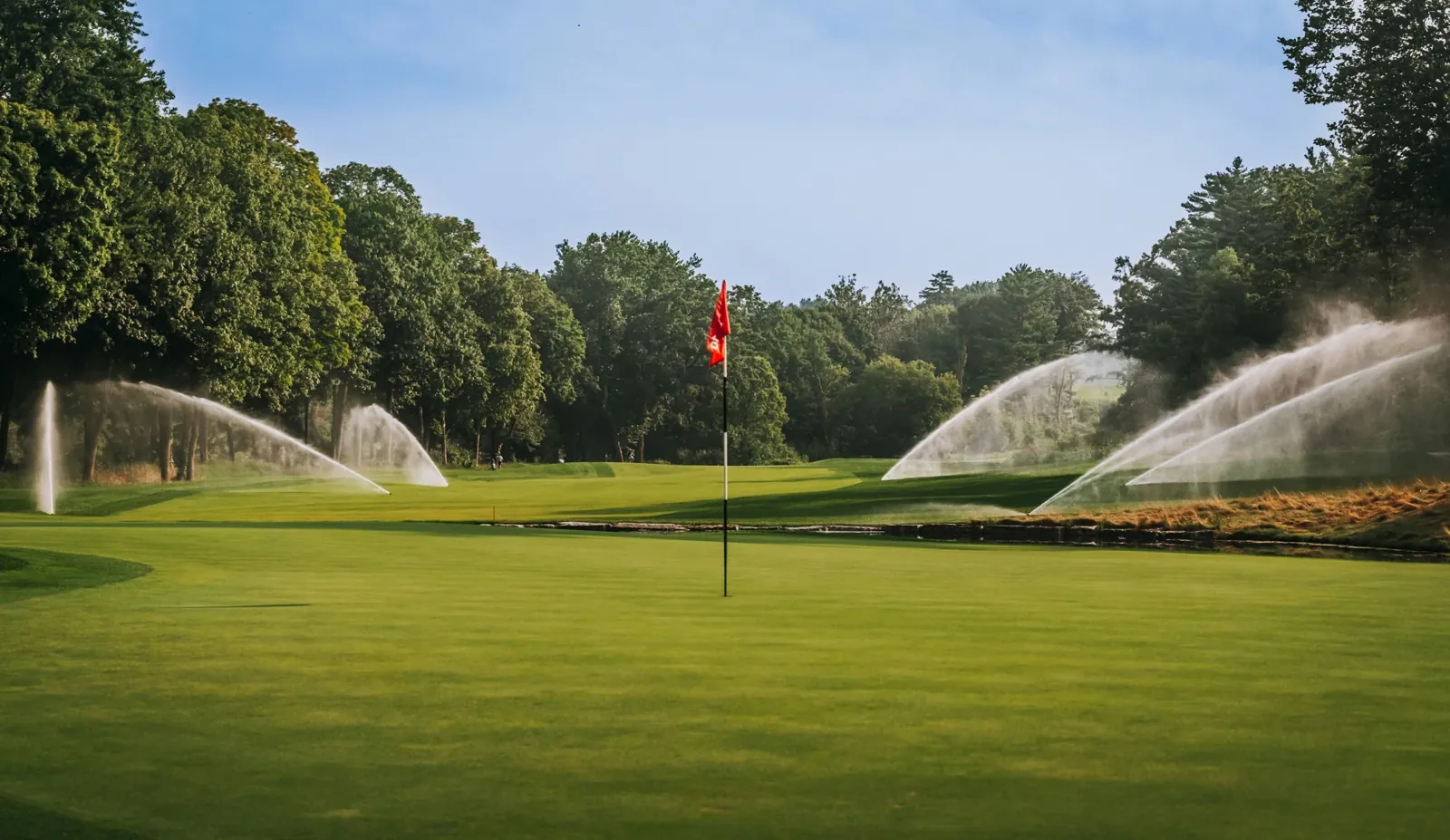
Most irrigation still runs on a clock: every zone gets the same minutes on the same nights, whether it rained yesterday or the soil on that bank has been dry for a week. The result is turf that is soggy in one corner and stressed in another, and a water bill that pays for both. Soil sensors and smart controllers let the ground, not the clock, decide when to water.
Why a fixed timer over- and under-waters
A timer knows one thing: the schedule someone set, usually in spring. What turf needs is enough plant-available water in the root zone, the band of soil where roots actually draw moisture. That changes every day.
Root-zone water goes down through evapotranspiration, or ET: water evaporating from the soil plus water the grass pulls up and releases through its leaves. ET rises with sun, heat, wind and dry air, and falls on cool, cloudy, still days. A July week can use far more water than a May week, and a timer set in May will not notice.
Soil type changes how much water the root zone can hold. Rain Bird's guidance for its SMRT-Y sensor lists typical field capacity (roughly, the water soil holds after it drains) at about 15% by volume for sand and about 44% for clay. Sand fills fast and dries fast. Clay holds more but takes water in slowly, so long cycles run off before they soak in.
Then there are differences inside one property:
- Slope. Water runs off a bank and collects at the bottom. The top dries first.
- Shade. Turf on a building's north side or under a tree line loses far less water than an open fairway.
- Exposure. Wind-exposed tees, compacted paths and turf beside hot pavement all dry faster.
A timer treats all of that as one schedule, so to keep the driest spot alive it overwaters everything else. The U.S. EPA's WaterSense program cites expert estimates that as much as 50 percent of the water U.S. homes use outdoors, mostly for landscape irrigation, is wasted through overwatering. Wet soil also favors disease, shallow roots and soft turf that ruts under equipment.
What in-ground sensors measure, and where they go
A soil sensor is a probe buried in the root zone that reports on a schedule. Depending on the model, it measures some or all of:
- Volumetric water content (VWC): the share of the soil volume that is water, as a percentage. This is the number irrigation decisions hang on.
- Soil temperature: useful for disease pressure and for seeding and fertilizer timing.
- Salinity, read as electrical conductivity (EC): a rising EC can warn of salt build-up, which matters where reclaimed or salty well water is used.
Makers bundle these differently. Spiio's sensor reports moisture, temperature, salinity and light. Soil Scout's Hydra100 and Rain Bird's SMRT-Y both report moisture, temperature and EC.
Placement matters more than brand:
- Pick representative spots. A sensor speaks for the area around it, so put it where soil, sun and sprinkler coverage are typical, not in a low spot, beside a head or under a lone tree.
- Bury at root depth. Too shallow and it reacts to every light shower; too deep and it misses stress until it is late.
- Plan for the worst case when sensors are few. University of Florida IFAS Extension advises that a single sensor on a controller should go in the driest irrigation zone, with run times on the other zones adjusted down so they are not overwatered.
- Add sensors where conditions split. Sun and shade, sand and clay, flat and sloped: each needs its own reading. The count depends on how many distinct conditions you have, not on a fixed ratio per acre.
How smart controllers use sensor and weather data
A smart controller changes the schedule based on conditions instead of running the clock. There are two main inputs, and many systems use both.
Weather-based (ET) controllers
These estimate how much water the turf used, from local weather plus site settings such as soil type, slope, shade and sprinkler type, then put roughly that much back. Hunter's Hydrawise platform, for example, adjusts irrigation with what it calls Predictive Watering, based on local weather data. UF IFAS reports that properly installed ET controllers reduced irrigation by 21 to 31 percent in residential landscape studies.
Soil moisture-based controllers
These read the ground directly. UF IFAS describes two setups:
- Bypass: the timer runs its schedule, but when the sensor reads wetter than a set threshold, the cycle is skipped. Rain Bird's SMRT-Y works this way, opening the common wire so the valves on that circuit do not run.
- On-demand: the controller starts irrigation when moisture drops to a low threshold and stops it at a high threshold.
In UF IFAS field plot studies in Florida, soil moisture sensor controllers used 35 to 54 percent less water than timers in dry weather, and more in normal rainfall. Treat these as research findings, not a promise; results depend on climate, soil and the old schedule.
Features vary by brand. Hydrawise can suspend watering when a connected soil sensor is active, and you choose which zones that sensor governs. Weather tells you what the day took out; the sensor tells you what is left in the ground. Together they catch what each misses alone.
One zone map for mowing, watering and sensing
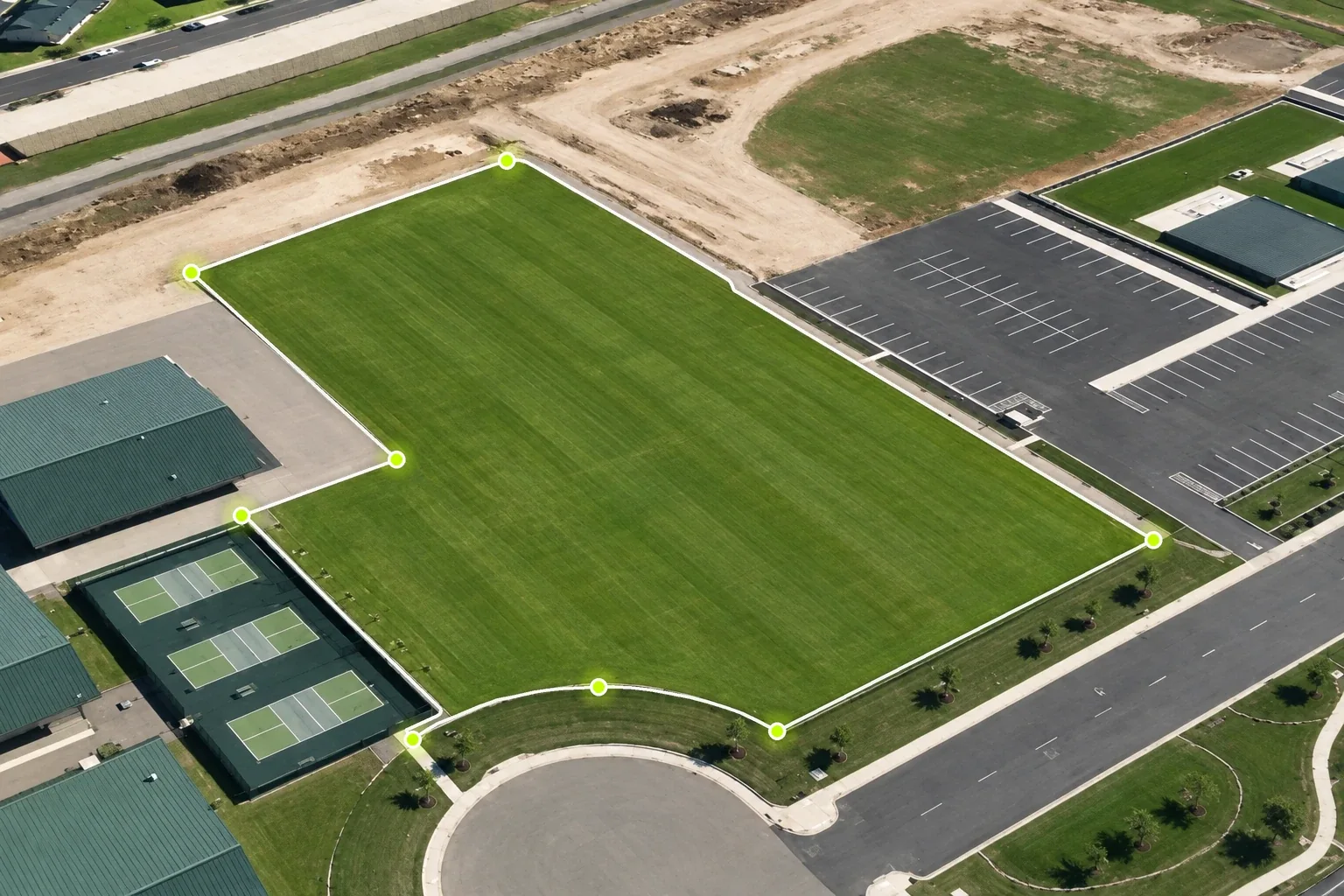
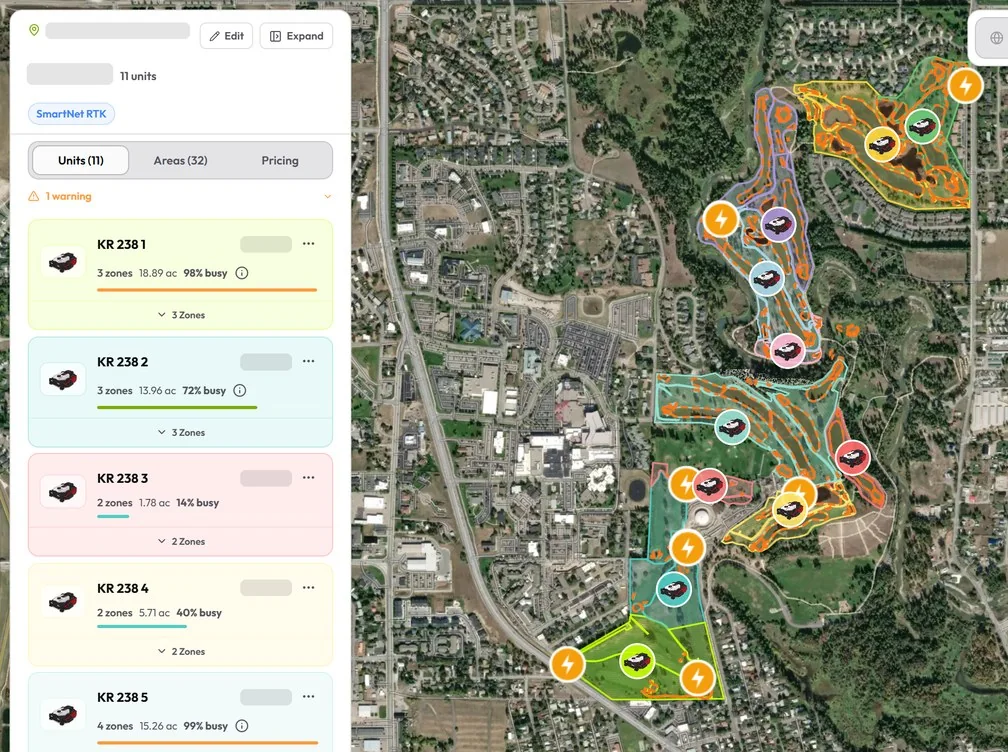
If you run autonomous mowers, you already have a zone map. Every mowing plan starts by splitting a property into areas by terrain, slope and use. Those lines are a good starting point for irrigation and sensing too, because what changes how grass grows (slope, shade, soil, traffic) also changes how it dries. In practice:
- Group irrigation so each zone covers ground that behaves alike, not just whatever the original pipe layout grouped together.
- Put at least one sensor in each group that behaves differently, starting with the steep, sunny and sandy ones.
- Schedule watering and mowing around each other, so machines are not cutting soft, freshly watered turf.
In Velocity, we map each property into zones and classify them by terrain type and slope, and we use that map as a reference when deciding where sensors go. To be clear about scope: Velocity does not list an irrigation or soil sensor integration today. The shared zone map is a planning approach, not a live data link.
What it takes to install and maintain
Sensor systems are not install-and-forget. Plan for four things.
Connectivity. Wired sensors, like the SMRT-Y, run a cable back to the controller. Cellular sensors, like Spiio's, send data straight to the cloud with no base station. Underground wireless sensors, like Soil Scout's, send to an on-site base station that uploads over cellular; Soil Scout says its sensors transmit from up to two metres below ground. Wiring means trenching and labor; wireless means checking signal coverage across the property.
Power. Wireless sensors run on sealed batteries. Spiio lists up to 5 years in its default setup; Soil Scout lists up to 20 years for the Hydra100. Ask what reporting interval the rating assumes.
Calibration. Moisture readings depend on soil type. Many sensors ship with a general calibration and let you tune thresholds in the field; the SMRT-Y has an auto-set feature for its threshold. Either way, check readings against a soil probe and the turf itself for the first few weeks.
Seasons and upkeep. In freezing climates, irrigation lines still need their fall blow-out and spring start-up. Buried wireless sensors are generally built to stay in the ground year-round, but confirm with the maker. Aerification and renovation can disturb probes, so map sensor locations and tell the crew. Someone must own the dashboard; a sensor nobody watches is an expensive stake. If sensors go in alongside machines, plan both installs together so trenching, base stations and boundary work happen once.
Limits, and questions to ask
- A sensor reads one spot. A dry patch a few metres away can be missed.
- Sensors do not fix bad coverage. A broken head or poor spacing leaves dry rings whatever the controller decides. Audit coverage first.
- Controllers act on zones, not spots. If one valve feeds a shaded strip and a sunny bank, no sensor can water them differently.
- People still decide. Superintendents syringe greens before an event, hand-water hot spots and build moisture ahead of heat. Data supports those calls; it does not make them.

Before you buy, ask:
- What does the sensor measure (moisture only, or also temperature and EC), and at what depth?
- Does it connect by wire, cellular or base station, and what coverage does our property need?
- What battery life does the maker quote, and at what reporting interval?
- Does it work with our existing controller or central system, and can it act per zone or only per controller?
- Is the controller WaterSense labeled? EPA labels both weather-based and soil moisture-based controllers.
- Who calibrates it, who watches the dashboard, and who gets the alert when a reading looks wrong?
- How many sensors does the vendor recommend for our property, and why those spots?
If you are planning irrigation changes alongside mowing automation, a TerraSync consulting plan can place sensors next to mowers and other machines on the same zone map. For how zone planning works on mowers, see our commercial robotic mowing guide and, for courses, the golf course guide.
FAQ
Do I need soil sensors if I already have a weather-based controller?
Not always, but they help. Weather data estimates what the turf used; a sensor confirms what is left. On properties with mixed soil, slope and shade, that gap can be large.
How many sensors does a property need?
Enough to cover each set of conditions that dries differently. A small, flat, uniform lawn may need one. A campus or course with sandy and clay areas, banks and shade needs more. Start with the driest, most sensitive areas.
Do sensors get in the way of mowing?
Fully buried sensors sit below the cutting height, so mowers pass over them. Keep a map of locations for aerification and renovation crews.
What happens when a sensor fails?
Ask whether the controller falls back to its normal schedule or stops watering, and make sure someone gets an alert.
See what automation looks like on your property.
We map every zone, size the fleet and price it before you buy anything.
Keep reading
- Guide
How robotic mowing works on large properties
How robotic mowers work at scale: RTK navigation vs boundary wire, zones, slope ratings, fleet sizing, charging, weather and the crew you still need.
7 min read · Sep 28, 2026
 Guide
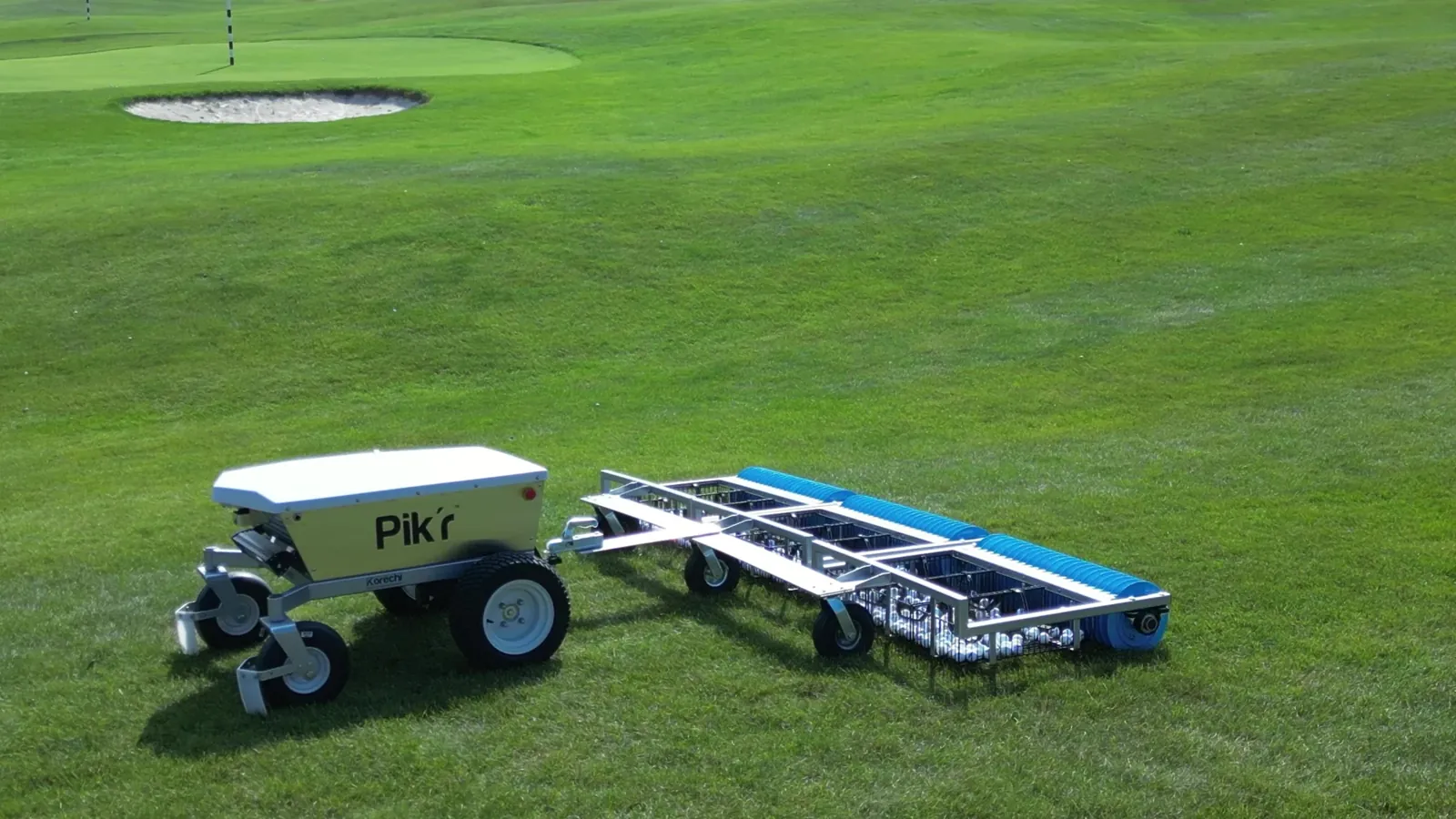
GuideAutonomous course and field equipment: range pickers, bunker rakes and line painters
How autonomous range pickers, bunker rakes and line-marking robots work, what they need from staff, where they fit, and what to ask before you buy.
6 min read · Sep 28, 2026
 Guide
GuideDrones for grounds teams: mapping, inspection and water
Survey drones, spray drones and the Caddis MANTA pond vessel for golf courses and campuses: where each fits, and the FAA rules (Part 107, LAANC, Part 137).
8 min read · Sep 28, 2026